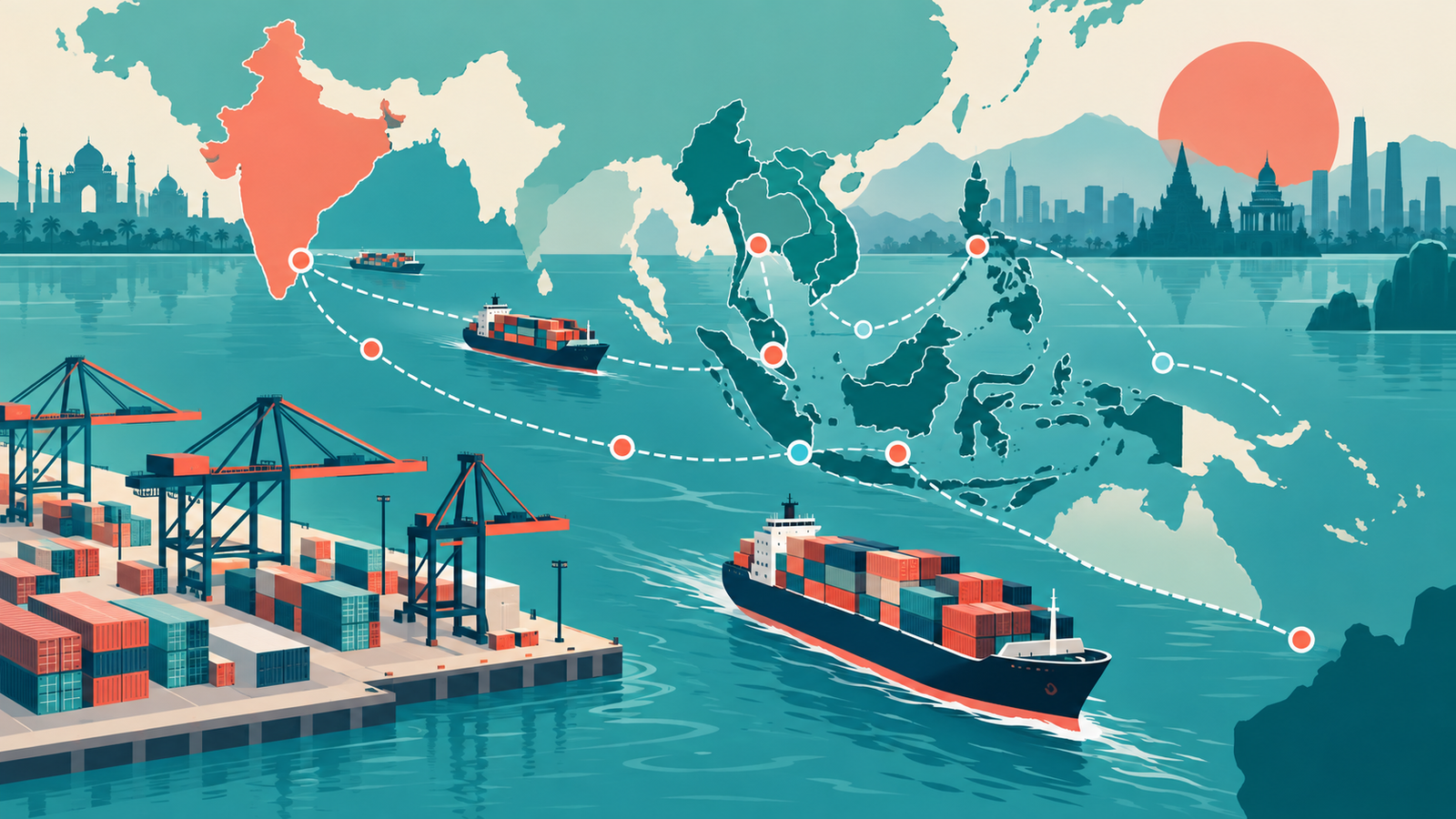
Prime Minister Narendra Modi arrived in Manila on 16 November with a crowded agenda: balanced trade, defence cooperation, maritime security, digital transformation, connectivity and supply-chain resilience, The Hindu BusinessLine reported ahead of the visit. The centrepiece economic issue is the stalled review of the ASEAN-India Trade in Goods Agreement (AITIGA), in force since 2010, against the backdrop of a trade deficit that has ballooned from roughly $6-7 billion when the pact began to over $50 billion now.
Bilateral trade between India and ASEAN stood at around $128 billion in FY26, with India’s exports at $38.41 billion, according to official figures cited by BusinessLine. New Delhi is pressing for a more balanced agreement and better market access for its exporters; ASEAN members want greater access of their own, and differences persist, a source tracking the matter told the paper. A breakthrough on the trade pact during the visit was considered unlikely.
The trade gap
| India’s trade deficit with ASEAN | US$ billion |
|---|---|
| FY26 | Over $50 bn |
| 2010 (AITIGA begins) | $6-7 bn |
What happened on Tuesday
Addressing the 23rd ASEAN-India Summit on 17 November, Modi said the region’s future “depends on cooperation, and not competition,” and put forward nine proposals, according to the Prime Minister’s Office:
- A long-term ASEAN-India Maritime Cooperation Plan covering connectivity, scientific research, disaster management, Coast Guard cooperation, maritime domain awareness and seafarers’ security
- A joint cyber forensics training programme
- ASEAN-India nuclear energy technical exchanges
- An ASEAN-India space hackathon
- Cooperation on mining and critical minerals
- Youth Connect: a youth summit, young parliamentarian exchanges and start-up hackathons
- Enhanced scholarships for ASEAN students at Nalanda University
- An ASEAN-India Creative Partnership Pavilion at WAVES 2027
- Free e-visas for tourists from ASEAN countries
The leaders adopted a joint statement on cooperation in disaster management. Modi noted that 2027 will mark 35 years of India-ASEAN ties and five years of the Comprehensive Strategic Partnership.
The same day, Modi joined US President Donald Trump, Japanese Prime Minister Sanae Takaichi and Australian Prime Minister Anthony Albanese for the first Quad leaders’ summit in over two years. Trump said the four nations had agreed on new critical-mineral deals, and the grouping is set to unveil a defence exercise featuring maritime patrol aircraft, Nikkei Asia reported. The Associated Press reported that Trump also announced an accelerator to speed joint AI work, and the Times of India reported that Mumbai will host the inaugural Quad Business Leaders Forum in 2027.
Also in the room
| Defence exports | $375 mn BrahMos missile deal with the Philippines; Vietnam agreement signed |
| Maritime track record | 2nd ASEAN-India Maritime Exercise held Sep-Oct 2026 |
| ASEAN membership | 11 members, with Timor-Leste newly on-boarded |
| Next milestone | 2027: 35 years of ties; Singapore takes over as chair |
Analysis: why it matters for business
The view below is ours, not the sources’.
The nine proposals are heavy on symbolism and capacity-building and light on tariff lines – deliberately so. The real economic negotiation is the AITIGA review, and nothing announced on Tuesday moves it. For Indian exporters in pharmaceuticals, agriculture, engineering goods and textiles, the review remains the file to watch: a $50 billion-plus deficit gives New Delhi leverage to demand better access, but it also gives ASEAN a reason to stall. Expect the deficit trend, not summit communiques, to set the pace.
Two quieter threads carry direct business implications. Critical minerals now sit on both the ASEAN and Quad agendas, and any Quad-level deal flow there matters for India’s electronics, battery and defence manufacturing ambitions. And defence exports are becoming a real line of business: the BrahMos deal with the Philippines, a follow-on agreement with Vietnam and expressed interest from other Southeast Asian buyers point to a regional market that barely existed five years ago. The free e-visa proposal, if implemented, would be the most immediately visible measure for ordinary travellers and the tourism trade.
Sources
- The Hindu BusinessLine, 16 Nov 2026 – Trade imbalance, defence, maritime ties to top Modi’s agenda
- Prime Minister’s Office, 17 Nov 2026 – PM participates in the 23rd India-ASEAN Summit in Manila
- Nikkei Asia, 17 Nov 2026 – Trump meets Quad leaders; critical mineral deals
- Business Today, 17 Nov 2026 – What PM Modi proposed at the summit